
How Does Sound and Vibration Therapy Differ from Traditional Massage?
The short answer
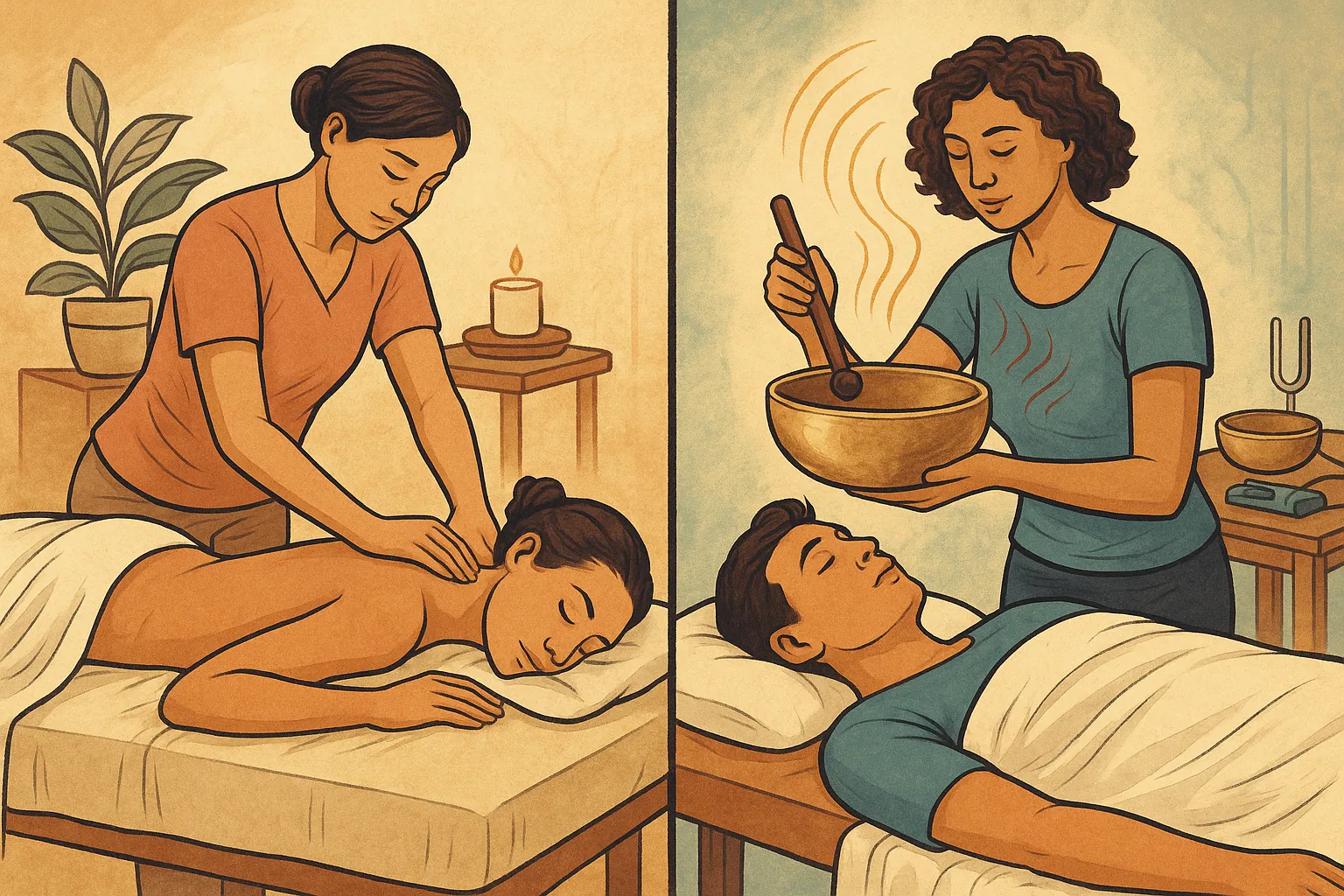
Traditional massage uses hands-on pressure to work on muscles and joints, while sound and vibration therapy uses tones or mechanical vibration, often with little or no touch. Both may help people relax, but the evidence for each is limited and varies by condition. Research on sound and vibration is smaller, so more rigorous trials are still needed.
Key points
- Massage applies pressure to soft tissue; sound therapy uses tones or vibration, often with little or no touch.
- NCCIH reports low-strength evidence that massage helps chronic low back pain.
- A 2024 review of 10 trials found whole body vibration exercise may help chronic low back pain.
- Sound sessions are usually clothed, which suits people who prefer minimal touch.
- Pacemakers, seizure history, pregnancy and recent surgery are reasons to ask a clinician first.
Contents (16)
Traditional massage uses hands-on pressure to mobilize muscles, fascia and joints. Sound and vibration therapy uses audible tones and/or mechanical vibrations, often with little or no physical pressure, with the aim of promoting relaxation and well-being. Massage is tactile and tissue-focused; sound and vibration is sensory and resonance-focused. Both may help you relax and feel better, but they work by different routes.
Sound and vibration practices have deep historical roots, and research on them is still growing and limited.
Health note: None of this is medical advice. If you have a medical condition, talk with a qualified clinician before starting any new therapy.
Defining Sound & Vibration Therapy
Core Modalities
Tuning forks & singing bowls
Metallic forks and metal or crystal bowls, including traditional Tibetan singing bowls, produce sustained tones. Practitioners hold forks near (or lightly on) the body, play bowls around you, or place bowls on the body for gentle vibration. Many people find these tones relaxing.
Gongs, drums & chimes
Large instruments create richly layered frequencies that can feel immersive. Sessions using gongs, drums and chimes are often called a sound bath, a practice where people lie down and are immersed in sound. Practitioners traditionally link it with the body’s energy centers, which is a belief rather than a measured effect, and people use it for relaxation and stress relief, and some for pain relief. You lie down while waves of sound wash over you.
Vibroacoustic beds & speakers
Specialized loungers or mats convert music or low-frequency signals into vibration you can feel through your body, like a subwoofer designed for therapeutic use. Practitioners describe the vibration as balancing, which is a tradition-based idea rather than a proven effect.
Binaural beats & recorded soundscapes
Headphones deliver slightly different tones to each ear, creating a perceived third beat that some people find calming. Nature sounds and ambient music are also used for relaxation and focus.
How It’s Thought to Work
Entrainment & nervous system regulation
One idea is that rhythmic sound may help the brain and autonomic nervous system “entrain” toward calmer patterns, supporting rest-and-digest activity and reducing arousal. This is a proposed mechanism that has not been firmly established. If it holds, it could also support reducing anxiety and mental clarity.
Resonance, fascia, and mechanotransduction
Vibration can travel through soft tissues and fluids, potentially influencing fascia gliding, breathing patterns and body awareness. Mechanotransduction, the way cells respond to mechanical input, may help explain why gentle vibration can shift muscle tone or perceived tension for some people. These are proposed explanations, not proven ones.
What Counts as Traditional Massage?
Popular Styles
Swedish, Deep Tissue, Sports, Myofascial, Thai
- Swedish: long effleurage strokes, moderate pressure, general relaxation.
- Deep Tissue: slower, targeted pressure into adhesions and deeper layers. Individuals with joint replacement should consult a professional before receiving this technique.
- Sports: performance and recovery focused, often with stretching.
- Myofascial: sustained, gentle pressure to improve fascia mobility. Those with joint replacement should seek professional advice prior to treatment.
- Thai: clothes-on, floor-based, includes assisted stretches and compressions.
Mechanisms of Action
Mechanical pressure on soft tissues
Massage physically deforms tissues, moving fluids, stretching fascia, mobilizing adhesions and possibly encouraging blood and lymph flow.
Circulation, lymph & pain-gate theory
One theory is that touch can reduce pain perception through “gate control” in the spinal cord, while improved circulation and lower muscle tone may add to relief. These are theories, and the evidence for each varies.
Key Differences at a Glance
Input: pressure vs. sonic/vibratory stimulus
- Massage: hands, elbows and tools apply pressure and shear.
- Sound/Vibration: acoustic waves and/or mechanical vibration act through hearing and whole-body sensation. In whole body vibration, a vibrating platform transmits vibration through the body.
Target: soft tissue vs. whole-body/neurological
- Massage: primarily muscles, fascia, joints.
- Sound/Vibration: described by practitioners as working mainly on the nervous system, breath and body awareness, and secondarily on soft tissue via resonance.
Setup: oils, table & undressing vs. clothes-on, instruments
Massage: usually on a table, under draping, with oils or lotions.
Sound/Vibration: typically clothes-on; you lie on a mat or bed while instruments are played or vibration is delivered.
Intensity, accessibility & sensory profile
- Massage: intensity ranges from light to very deep; requires direct contact and therapist availability.
- Sound/Vibration: often gentler and more accessible for people who avoid touch, people who are sensitive to sensation (with adjustments), or those who prefer minimal physical contact.
Overlapping Benefits (Where They Meet)
People commonly use both to:
- Feel less stressed and anxious
- Wind down and sleep more easily
- Ease muscle tension and discomfort (through different mechanisms)
- Build body awareness and mindfulness
- Support recovery and a sense of emotional well-being
How well each works for these goals varies, as the research section below shows.
When Each One Shines
Best use cases for sound & vibration
- You want deep relaxation without physical pressure.
- You’re post-exercise and want gentle winding down.
- You’re touch-averse or find touch uncomfortable.
- You’re exploring breath, meditation, or trauma-informed approaches where minimal touch is preferred.
- You want an adjunct to meditation, yoga, or mindfulness.
- You are looking for a contemplative or spiritual practice, which many people find in sound work.
Best use cases for massage
- You have localized tightness, trigger points, or range-of-motion limits.
- You’re recovering from training and want hands-on tissue work.
- You want relief from desk-related neck or shoulder strain.
- You’re seeking specific work on scars or adhesions (where appropriate and cleared by a professional).
What the Research Suggests (In Plain English)
Evidence landscape for sound/vibration
Research on sound and vibration is small and methods vary widely. A 2024 systematic review of 10 randomized trials found that whole body vibration exercise improved pain, disability, balance and proprioception in people with non-specific chronic low back pain. The authors cautioned that this must be read in light of the small number of studies, small sample sizes and varied protocols. That review covers vibration exercise on a platform, not sound baths or bowls, so more rigorous trials are still needed for those.
Evidence landscape for massage
The National Center for Complementary and Integrative Health (NCCIH) reports that massage may give short-term benefit for neck pain, although it also cites a Cochrane review that found the effectiveness for neck pain uncertain. For chronic low-back pain, NCCIH cites a review that found evidence massage was helpful but the strength of evidence was low. It also says the long-term effects of massage for low-back pain have not been established. Effects vary by technique, frequency and individual response.
What’s still uncertain
- Which specific frequencies and protocols are best for which conditions.
- How long benefits last and the ideal dose (minutes per week).
- Individual differences: why some respond strongly and others less so.
Safety, Risks & Contraindications
Sound/vibration cautions
- Hearing sensitivity, tinnitus, migraines: start with lower volume and softer instruments.
- Epilepsy or seizure history: avoid strobing lights and check with a clinician before using binaural beats or intense sessions.
- Cardiac devices (pacemakers) & pregnancy: consult a clinician; avoid placing vibrating devices directly over the abdomen or chest unless cleared.
- Recent surgeries or acute injuries: gentle only, or wait until cleared.
- Blood pressure concerns: if you have blood pressure issues, monitor how you feel and consult a clinician before participating.
Massage cautions
- Acute inflammation, infections, open wounds: avoid until healed.
- Blood clots, severe osteoporosis, bleeding disorders: seek medical guidance; avoid deep pressure.
- Cancer care or pregnancy: choose trained practitioners with appropriate certifications and protocols.
- Nerve entrapments or severe pain: lighten pressure; coordinate with healthcare providers.
What a Typical Session Looks Like
Sound/vibration session flow
- Intake & goals: stress relief? sleep? emotional processing?
- Setup: you stay clothed, lie comfortably; eye mask offered.
- Immersion: practitioner plays bowls and gongs or activates a vibroacoustic bed; volume and intensity adjusted to comfort.
- Breath & pacing: gentle guidance to slow the breath and lengthen exhales.
- Integration: quiet time at the end; hydration and aftercare tips.
Massage session flow
- Intake & assessment: pain map, range-of-motion checks, preferences.
- Draping & positioning: you undress to comfort level; therapist uses oils.
- Techniques: sequences adapted to your goals; pressure negotiated in real time.
- Reassessment: quick range-of-motion check and self-care cues (e.g., stretches).
- Aftercare: hydration, gentle movement, and spacing of future sessions.
Tools, Spaces & Atmosphere
Instruments & tech for sound/vibration
- Metal or crystal singing bowls, gongs, chimes, tuning forks.
- Vibroacoustic mats and beds with embedded transducers.
- Quality speakers or headphones for curated soundscapes.
- Soft lighting, acoustically mindful room, minimal external noise.
Tables, oils & technique for massage
- Supportive massage table with bolsters and adjustable face cradle.
- Neutral, hypoallergenic oils or lotions; heated towels.
- Clean, quiet environment with clear communication about pressure and consent.
Cost, Availability & Choosing a Practitioner
- Cost: Rates vary by practitioner, region and equipment, so ask before you book.
- Availability: Massage is widely available; sound and vibration depends on region.
- Credentials: Look for training certificates, scope of practice clarity, and client reviews.
- Fit: Schedule a brief consult, discuss goals and sensitivities, and ask about session structure and aftercare.
Combining Both (Sequencing That Works)
Pre-massage priming with sound
Some people begin with 5 to 10 minutes of gentle sound to settle in before hands-on work.
Post-massage integration with vibration
Some people finish with a short, low-frequency vibration session to stay relaxed after tissue work.
Simple at-home routines
- 10-minute breath practice with a soft drone playlist before bed.
- A small, low-intensity vibration mat (if appropriate) for post-workout relaxation.
- Short, guided body scan with headphones to build body awareness.
Myths vs. Facts
- Myth: Sound therapy is “just music.”
Fact: It can involve live instruments, chosen tones and mechanical vibration, though claims that specific frequencies treat conditions are not established. - Myth: Deep pressure is always better.
Fact: More pressure isn’t always more effective; people respond differently. - Myth: One session “fixes” everything.
Fact: Results vary, and many people find regular practice more useful than a single session. - Myth: If I’m touch-averse, I can’t get bodywork benefits.
Fact: Sound and vibration offer a non-touch route to relaxation and body awareness.
Step-by-Step Decision Guide
- Clarify your aim: stress relief, sleep, pain, range of motion, emotional processing.
- Check constraints: touch comfort, medical considerations, time, budget.
- Pick your primary: tissue-focused (massage) or sound-focused (sound and vibration).
- Match intensity: deep vs. gentle; live instruments vs. recorded; sports vs. Swedish.
- Trial & iterate: try 2 to 3 sessions; track sleep, mood, pain, range of motion.
- Combine strategically: brief sound before or after massage if you like both.
- Maintain at home: short daily practices to keep up what works for you.
Conclusion
Sound and vibration therapy and traditional massage can both help many people feel calmer and more comfortable, but they take different routes. Massage applies skilled, mechanical pressure to mobilize soft tissues and joints. Sound and vibration uses acoustic waves and felt resonance, with little or no touch. Your best choice depends on your goals, preferences, medical context and how your body responds. Many people combine them: sound to settle in, massage for targeted work, and simple practices at home in between.
Frequently asked questions
Is sound and vibration therapy suitable if I dislike being touched?
Often, yes. Most sessions are fully clothed and involve minimal or no touch, which many people who prefer a non-contact approach find comfortable.
Can sound therapy replace massage for tight muscles?
Some people find it softens muscle tension, but there is no good evidence that it replaces massage. Targeted manual techniques may still suit specific adhesions or mobility work better.
How many sessions will I need to feel results?
Many people say they feel calmer after one session. Results vary, so you could try a short series, for example weekly for 3 to 6 weeks, and reassess.
Are there people who shouldn’t try vibration?
If you have a pacemaker, seizure history, are pregnant, or have recent injuries or surgeries, consult your clinician and choose gentle, practitioner-guided approaches.
Can I do sound therapy at home?
Yes, you can use good headphones, soft drones or nature soundscapes, and simple breathwork. Keep volume moderate and focus on slow, comfortable breathing.