
How to Balance Chakras at Home?
The short answer
To balance chakras at home, set an intention, then work through the seven chakras with meditation, affirmations, gentle yoga, and sound. Ten to fifteen minutes a day is a simple start. Chakras are a spiritual tradition rather than a measured part of the body, so treat this as a relaxing routine.
Key points
- Start by setting an intention, then meditate on each chakra from root to crown.
- Affirmations, gentle yoga, crystals, and sound are common add-ons in chakra practice.
- Beginners are advised to avoid headstands and shoulder stands, according to NCCIH.
- Journaling, mindfulness, and time in nature support a simple daily habit.
- Chakra practice is not medical care and does not replace it.
Contents (8)
Introduction to Chakras
What Are Chakras?
Imagine your body as a house, with chakras as the light switches. In yoga tradition, chakras are energy centers in the body. When they are flowing freely, everything is said to feel bright and energized, and when they are blocked, things feel off. Chakras are a spiritual concept. Science has not shown that they exist as parts of the body.
The Seven Main Chakras Explained
Here is a quick breakdown of how tradition describes them:
Root Chakra (Muladhara)
Located at the base of the spine. It is linked with security and survival. In tradition, feeling anxious or unsafe points here.
Sacral Chakra (Svadhisthana)
Right below your belly button. This one is linked with creativity and pleasure. Feeling stuck or uninspired? Practitioners say to look here.
Solar Plexus Chakra (Manipura)
In your upper abdomen. This is the power center, linked with confidence. Feeling powerless or indecisive points to an imbalance in this tradition.
Heart Chakra (Anahata)
Center of the chest. It is linked with love, compassion, and forgiveness. Closed off emotionally? Tradition says this is the one to open.
Throat Chakra (Vishuddha)
Your throat. It is linked with communication and truth. Struggling to express yourself? Practitioners point here.
Third Eye Chakra (Ajna)
Between your eyebrows. Intuition and vision. If your gut feels off, tradition says this one needs attention.
Crown Chakra (Sahasrara)
Top of your head. Spiritual connection. Feeling disconnected or lost? This is the chakra said to be involved.
Why Balancing Chakras Matters
The Impact of Blocked Energy
In chakra teaching, stuck energy is like a traffic jam in the body, and balancing clears the way. This is a metaphor from tradition. Tiredness and other symptoms have ordinary and medical causes, so see a doctor if they persist.
Emotional, Physical, and Mental Benefits
Followers describe better sleep, clearer thinking, more joy, deeper relationships, and more inner peace. These are personal reports, not research findings.
How to Know If Your Chakras Are Out of Balance
Common Signs and Symptoms
In chakra teaching, these are signs of imbalance. They also have many other causes:
- Anxiety or depression
- Chronic fatigue
- Trouble making decisions
- Feeling stuck or emotionally numb
- Physical pain in areas linked to certain chakras
How to Perform a Self-Assessment
Close your eyes, breathe deeply, and visualize each chakra. Do any feel “off” or dull? This is a reflection exercise, not a diagnosis.
Step-by-Step Guide to Balancing Chakras at Home
Step 1: Set Your Intention
Start with a clear goal. “I want to feel grounded.” “I want to speak my truth.” This anchors your practice.
Step 2: Practice Chakra Meditation
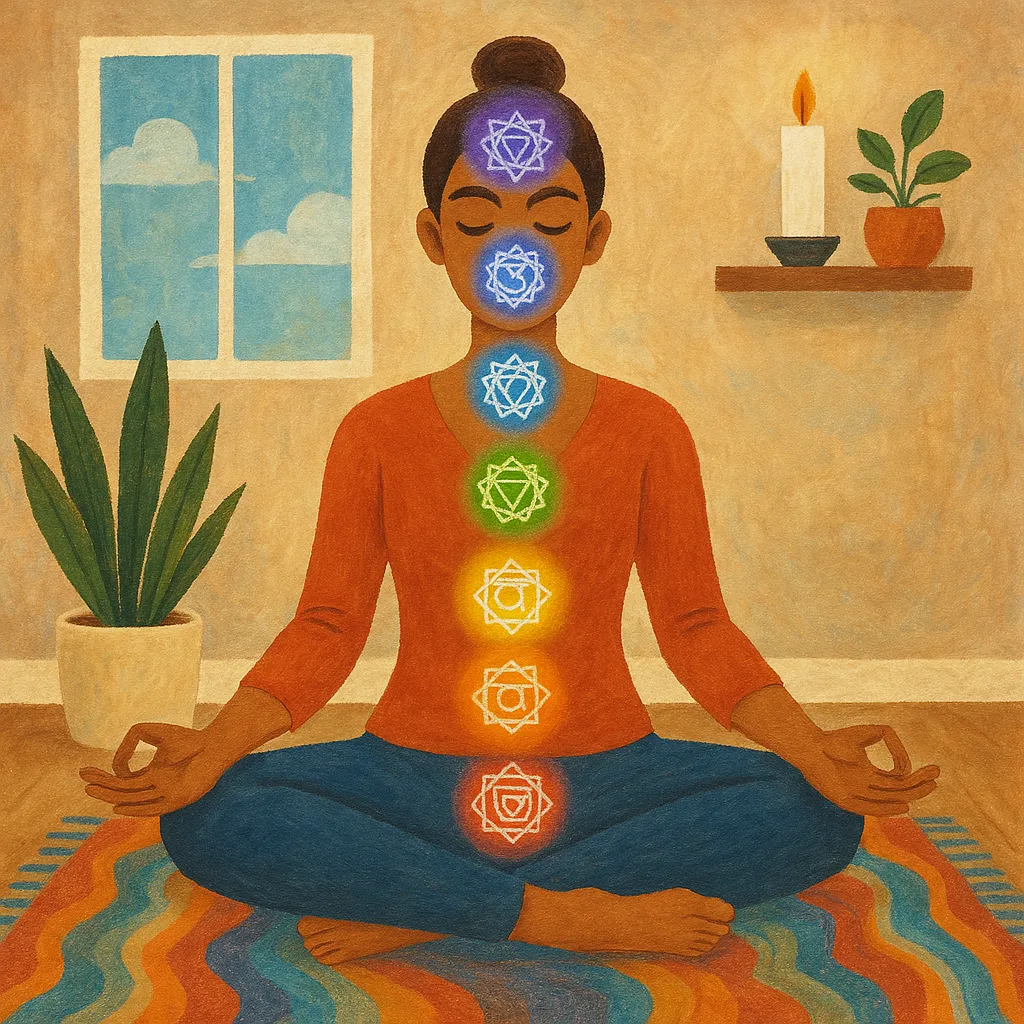
Sit comfortably. Focus on each chakra starting from the root to the crown. Visualize a colored light glowing brighter with each breath. Use this sequence:
- Red (Root)
- Orange (Sacral)
- Yellow (Solar Plexus)
- Green (Heart)
- Blue (Throat)
- Indigo (Third Eye)
- Violet (Crown)
A common suggestion is 10 to 15 minutes daily.
Step 3: Use Chakra-Affirmations
Examples:
- “I am safe and grounded.” (Root)
- “I allow creativity to flow.” (Sacral)
- “I stand in my personal power.” (Solar Plexus)
- “I give and receive love freely.” (Heart)
- “I speak my truth.” (Throat)
- “I trust my intuition.” (Third Eye)
- “I am connected to the divine.” (Crown)
Repeat them during meditation or throughout the day.
Step 4: Incorporate Chakra-Colored Foods
In tradition, foods matching each chakra’s color are linked with it. This is a custom, not nutrition advice.
- Root: Beets, potatoes
- Sacral: Oranges, carrots, nuts
- Solar Plexus: Bananas, corn, grains
- Heart: Leafy greens, broccoli
- Throat: Blueberries, herbal teas
- Third Eye: Grapes
Step 5: Practice Chakra Yoga Poses
In yoga tradition, each chakra has yoga poses linked with it. For example:
- Root: Mountain pose, Warrior I
- Sacral: Hip openers like Pigeon pose
- Solar Plexus: Boat pose, twists
- Heart: Camel, Cobra
- Throat: Shoulder stand, Plow
- Third Eye: Child’s pose
- Crown: Headstand, meditation poses
The National Center for Complementary and Integrative Health says yoga is generally considered safe for healthy people when performed properly under the guidance of a qualified instructor. It advises beginners to avoid extreme practices such as headstands, shoulder stands, the lotus position, and forceful breathing, so skip those until you have had instruction. Injuries such as sprains and strains can occur.
Step 6: Use Crystals and Gemstones
Each chakra has matching stones in tradition:
- Root: Red Jasper, Hematite
- Sacral: Carnelian
- Solar Plexus: Citrine, Tiger’s Eye
- Heart: Rose Quartz, Jade
- Throat: Lapis Lazuli, Aquamarine
- Third Eye: Amethyst
- Crown: Clear Quartz, Selenite
Place them on your body, carry them, or keep them nearby.
Step 7: Sound and Frequencies
In chakra practice, sound is said to move energy.
- Try binaural beats, Tibetan singing bowls, or solfeggio frequencies.
- Humming “OM” is a simple way to start.
Lifestyle Habits That Support Chakra Balance
Daily Mindfulness
Be present. Breathe, pause, observe.
Journaling for Emotional Release
Write what you feel, with no filter.
Nature and Grounding Techniques
Walk barefoot on grass. Garden. In tradition, time in nature is especially good for the root chakra.
Tools and Resources for Home Practice
Apps and Guided Meditations
- Insight Timer
- Calm
- Headspace
- YouTube (search “Chakra healing meditation”)
Books and Online Courses
- Wheels of Life by Anodea Judith
- The Book of Chakra Healing by Liz Simpson
- Udemy and Gaia have visual courses
Conclusion
Balancing your chakras at home is a relaxing routine, and it is also a spiritual practice for those who see it that way. It takes no fancy equipment, just your intention and a little time. Keep medical care for medical needs.
Frequently asked questions
How often should I balance my chakras?
There is no research-based schedule. Some people practice a few times a week, and even once a week is a reasonable start.
Can chakra balancing help with anxiety or depression?
Some people find the quiet time calming, but it is not a substitute for medical or psychological treatment.
Do I need to believe in spirituality for this to work?
No. You can treat it as a self-care routine, and the spiritual side is optional.
Is it safe to do chakra healing by myself at home?
The National Center for Complementary and Integrative Health says [meditation practices usually are considered to have few risks](https://www.nccih.nih.gov/health/meditation-and-mindfulness-what-you-need-to-know), though few studies have looked for harmful effects. Go at your own pace, stay grounded, and stop if something feels wrong.
What’s the fastest way to balance a single chakra?
Focus on it with breathwork, a specific affirmation, and color visualization for 5 to 10 minutes. That is a quick way to practice.